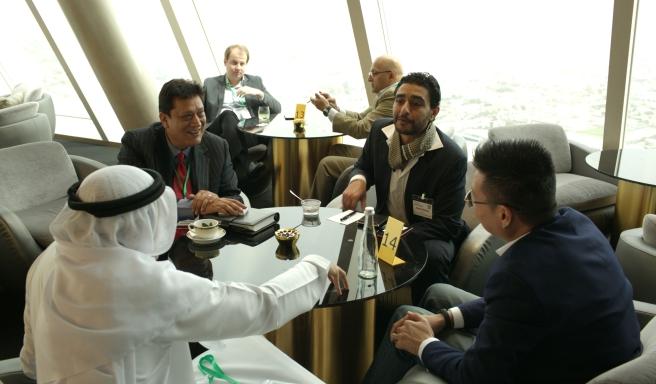
At a recent roundtable hosted by the Global Investment Leaders Club, a group of international investors and tech pioneers gathered to answer one of the industry’s most complex questions: What is the next big thing in tech after AI? Even though the world remains fixated on large language models and generative bots, the consensus suggests we are entering a "convergence era" where AI is no longer the destination, but more of a foundational engine for a new physical and digital reality.
The primary shift identified by the gathering is the move from "foundational" AI—calculating and answering questions—to "agentic" and physical AI. Pasi Pohjala, Founder and CEO of ATG Consulting, highlighted autonomous machines and robotics as the immediate frontier. "AI is a small essential component," Pohjala noted, but the true disruption lies in making these things "more autonomous" in the physical world.
This sentiment was backed up by Giuseppe Folonari, Managing Partner of High Tides, who described this phase as "different waves of implementation of AI spreading into the physical world". From robotaxis to "mobile self-propelled robotics," investors are more and more looking for ways AI can manipulate and improve tangible industries.
Beyond the technology itself, the roundtable explored how these advancements are fundamentally rewriting the business landscape. Leah Solivan, Managing Director of Precedent.vc, presented a startling vision for the future of entrepreneurship.
"We're going to see billion-dollar businesses created with less than 10 people," Solivan predicted. She noted that teams are staying smaller and gaining traction faster because AI handles the heavy lifting of engineering and customer service. This efficiency shift suggests that "domain expertise" is becoming more valuable than sheer headcount.
For those looking five to ten years out, the focus shifted toward more complex frontiers. Faisal Baig, Chief Investment Officer at ASFAR, pointed to quantum computing as the force that will take technology to a "completely different level" by solving complexities currently beyond our reach.
However, this massive increase in computing power comes with a physical cost: energy. "Energy is one of those categories... that is really unavoidable in the next decade," stated Andrea Ballarini, Entrepreneur | Investor at Forward Investments. Investors like Fredrik Sandvall, Associate Director at SBRConsulting, and Gurpreet Chandhoke, Managing Partner, Investor at Mosswood Group LLC, are already tracking surges in alternative energy solutions, specifically nuclear and fusion, to power the next generation of data centers.
Furthermore, space is emerging as the ultimate platform. Andrea highlighted SpaceX not just as a rocket company, but as a platform through Starlink. This orbital connectivity is expected to provide the "perfect combo" for the next wave of entrepreneurs to build global, extraterrestrial businesses.
Conclusion: The Convergence Era
The roundtable concluded that the "Next Big Thing" isn't a single technology, but the convergence of multiple stacks. As Jonny Barragan, Co-Founder, Managing Partner of Barclo put it, we are on the "precipice of this new cycle of human progress" where quantum, AI, and next-gen energy meet.
The era of "broad foundational models" may be maturing, but the current challenge for the investment community remains the same: identifying these seismic shifts before they hit the mainstream. The next decade of tech will not be defined by software alone, but by the intelligent application of "digital brains" to the physical world—from deep-sea data centers to the next frontier of AI-driven medicine. For those positioned at the intersection of energy, robotics, and computing, the next big thing isn't just a trend; it is the blueprint for a new global economy.