Emma’s dog Bailey is 12 years old, managing kidney failure, a bladder tumour, and liver problems. There are four people in her household, and on the days she works, half the village checks in on him. When asked how she keeps track of his condition at home, her answer is immediate and unadorned: “We just keep an eye on him.”
A few thousand miles away, another owner spent four years managing her terrier Rex’s diabetes. Twice-daily insulin injections, weekly home blood tests, glucose readings emailed to the vet every few weeks. She did everything right. And yet the thing that scared her most was the thing she couldn’t measure. “You can’t see it,” she says. “The only way you see it is the losing weight, and it’s so gradual that you don’t see it until it’s upon you.”
These are not unusual stories. They are the ordinary reality of managing a chronically ill animal, and they point to a structural problem embedded in the way veterinary care has always worked. Clinical decisions are made on snapshots: blood tests at consultations, behaviour inferred from external wearables, owner observations. Between those moments, the animal's biology is largely invisible. More than 50% of pet health issues never reach a vet. One in four owners forget to dose at the correct interval. Disease drift quietly erodes treatment effectiveness, and no one sees it happening.
"At least half of my time is spent dealing with chronic cases. The challenge is rarely diagnosis — it's what happens between visits."
— Clinical director, companion animal practice
It is not a failure of veterinary medicine. It is a reflection of the tools available to it. Until now, there has been no way to access continuous biological data from a living animal without repeated blood draws or a clinical visit.
iQ Sense, a biosensing company co-founded by Brendan Emery and Madhu Jambunathan, is building that capability.
A third category
The existing landscape of animal health monitoring falls into two broad categories. Established diagnostic blood testing provides high-quality biological data, but only at discrete time points during visits. Behavioural wearables provide continuous data, but without any biochemical signal: movement and activity, not biology.
Neither solves the problem. What has been missing is a way to access continuous, in-vivo biochemical data from a living animal without repeated blood draws, without clinic visits, without gaps.
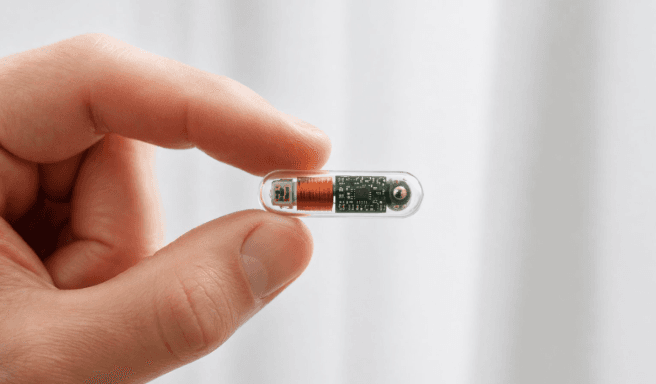
At the core of the iQ Sense platform is a 22mm bio-glass implant housing a proprietary optical biosensor microchip 2.1mm in diameter. Once implanted, it continuously measures molecular biomarkers from within the animal's body, alongside internal temperature and location, transmitting data via NFC to a paired collar. The collar extends the picture further, capturing movement, behaviour, heart rate and respiratory rate. Together, the two components deliver something that has not previously existed in veterinary care: a complete, continuous biological profile of the animal, updated in real time.
The chip architecture is designed to carry up to three biomarkers, configurable by species and condition. Currently validated across glucose and zoonotic disease markers, additional markers are under active development to cover a broader range of conditions. When a signal changes, an alert is triggered. The vet gets the call before the animal deteriorates.
No blood draws. No clinic visit required. No six-week blind spot.
iQ Sense is positioned as a monitoring platform rather than a diagnostic device. That distinction matters commercially: it bypasses the multi-year regulatory approval cycles that constrain diagnostic tools, enabling faster deployment into markets that are already primed to pay.
Why now
The technology to do this in a miniaturised, biocompatible, implantable form has only recently become viable. Advances in optical biosensing, materials science and chip fabrication have converged in a way that simply was not achievable five years ago. The iQ Sense team has achieved 100% chip fabrication yield and validated its initial biomarkers in vitro, a significant technical milestone for a platform at this stage.
Emery brings deep commercial experience scaling animal health businesses to over $200M in revenue across global pharmaceutical and veterinary markets. He is clear about what the platform changes: “The vet has always had to make decisions based on what they can see at the moment the animal is in the room. We’re giving them a continuous picture, so that by the time the owner calls, they already have the data they need.”
Co-founder Jambunathan brings 25+ peer-reviewed publications from leading semiconductor and nanotechnology research institutes, and has translated that research into an optical biosensor architecture the company believes has no direct equivalent in animal health today. Three core patents have been filed.
The market it sits inside
The companion animal chronic care market in Europe, the United States and Australia represents an addressable pool of 43 million patients: animals already in treatment, already attended by vets, already managed by owners willing to pay for better outcomes. The broader pet population across those regions numbers 377 million.
|
$49.6B Total addressable market across EUR, USA & Australia |
43M Chronic companion animal patients in Phase 1 regions |
$2.4B Merck’s acquisition of Antelliq — the closest strategic comparable |
The commercial logic is that iQ Sense sits inside a care pathway that already exists. The pharmaceutical companies supplying chronic disease treatments have a direct financial interest in therapy persistence. If an animal's condition drifts undetected, treatment stops. Three Tier-1 global veterinary pharmaceutical companies have already signed NDAs with iQ Sense, and a paid pilot framework is in place.
The platform has also attracted validation from an unexpected direction. The Australian Government awarded iQ Sense a $565K AUD non-dilutive R&D grant specifically for its biosecurity application: the detection of zoonotic diseases at the animal-human interface. That a government biosecurity programme recognised the platform's potential before it reaches commercial scale speaks to the breadth of what continuous in-vivo monitoring can do when applied beyond chronic pet care.
The revenue model follows the data: hardware at implant, a monthly subscription tied to treatment duration, and longitudinal biomarker datasets that grow more valuable over time. As the installed base scales, so does the dataset, and with it the strategic interest of potential acquirers for whom that data represents something they cannot build quickly themselves.
Beyond companion animals
The same implant technology, reconfigured for different biomarkers, applies across equine health, where performance and breeding monitoring commands significant per-animal value, and into livestock, where metabolic, infectious and zoonotic disease monitoring at herd scale carries direct biosecurity and emissions implications. The platform's expansion roadmap runs from chronic companion animals today through to cattle by 2030, with each new species an additional revenue layer on the same underlying IP.
For investors thinking about the One Health framework, the growing recognition that animal, human and environmental health are deeply interconnected, continuous biological visibility at scale is not a niche product. It is infrastructure.
"If we had continuous or lifetime monitoring solutions, it would make things significantly easier."
— Veterinary leader, quoted in iQ Sense clinical research
When Rex’s owner was asked what a magic wand would give her, what one thing would have changed her four years of managing his diabetes, her answer took no time at all: “Knowing more what’s going on.” It is, as it turns out, the same answer the veterinary profession has been waiting for.
The company is currently raising pre-seed capital to complete in-vivo validation and initiate first partner revenue, with SEIS/EIS approval in place for UK investors. For those interested in learning more, contact details are below.