The Uncomfortable Contradiction
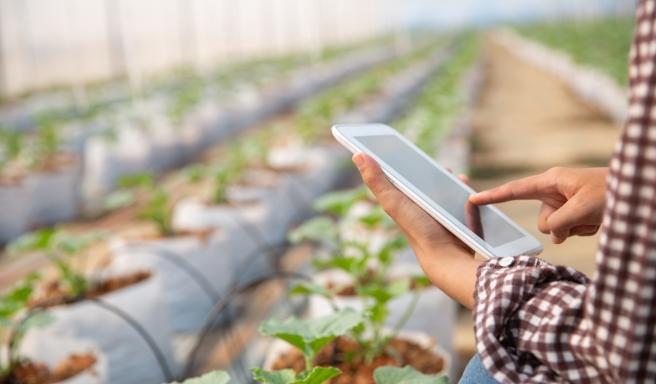
Greenhouse agriculture has reached an uncomfortable contradiction. On the surface, it is one of the most advanced forms of food production ever developed. Climate systems are tightly controlled. Irrigation is sensor-driven. Nutrient delivery is precisely calibrated. Light spectra, humidity, CO₂ levels, and temperature are all managed with increasing sophistication. In many ways, the modern greenhouse is a highly engineered biological system.
And yet, beneath this complexity, something fundamental has not changed for decades: most of the space inside a greenhouse produces nothing.
The industry has spent years improving efficiency at the level of the square metre, while leaving the majority of the greenhouse volume structurally underused. The result is a system that is technologically advanced but spatially incomplete. This is becoming a critical constraint.
The Land Equation
Agriculture is now defined by a simple but increasingly unforgiving equation: demand is rising, while the resources required to meet it are tightening. Land is limited. Water is under pressure. Labour is more expensive and harder to secure. Energy costs continue to rise. At the same time, greenhouse operators are expected to deliver higher yields, greater consistency, and stronger margins from infrastructure that is already capital-intensive and resource-heavy.
For a long time, the answer was expansion: build more greenhouses, increase the footprint, and scale horizontally. But that logic is breaking down because modern greenhouse systems have already extracted much of the value available from horizontal optimisation. Irrigation systems are highly efficient. Climate control is highly precise. Nutrient delivery is highly refined. The incremental gains left within the existing model are becoming smaller, more expensive, and slower to achieve.
Operators are no longer facing a question of efficiency. They are facing a question of structure.
The One-Square-Metre Limitation
Despite decades of technological advancement, greenhouse production still operates on a fundamentally flat assumption: one square metre of floor space produces one square metre of crop. Everything above that plane remains largely unused. The vertical volume inside a greenhouse, the space between the crop canopy and the roof, is heated, cooled, ventilated, and maintained, but contributes very little to production. In effect, a significant portion of the controlled environment exists as a cost without output.
This is not due to a lack of innovation. It is due to unresolved engineering constraints. Multi-layer cultivation introduces real challenges: uneven light distribution, airflow disruption, harvest accessibility, maintenance complexity, and system integration within existing greenhouse infrastructure. These problems are solvable in theory, but historically difficult to solve in a way that scales economically across real-world operations.
So the industry optimized the only dimension that worked reliably: the horizontal one. But that optimisation curve is now flattening. Further gains in productivity within a single layer are becoming marginal, while the economic pressure on growers continues to intensify. At this point, there are only two ways forward: expand the footprint, or rethink the use of the space already enclosed.
The second option is where the next phase begins.
"For decades, the industry has focused on optimising the square metre. We started asking a different question: How can we optimize the cubic meter?" That question defines a shift in thinking, and it is where FrugalTec enters the picture.
Unlocking the Third Dimension
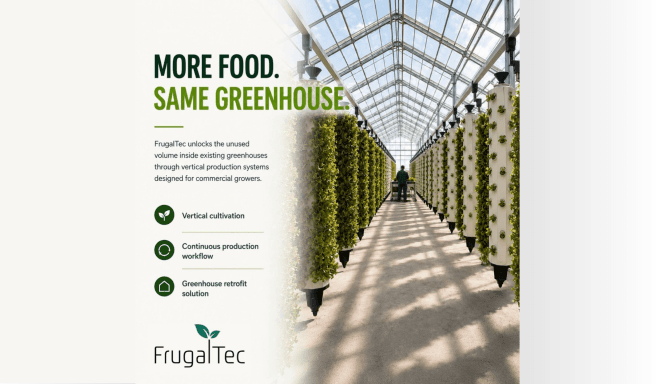
FrugalTec, founded in Switzerland in 2022, is built around a single premise: the greenhouse is not a flat system, it is a volume that has never been fully activated. Rather than replacing existing infrastructure, FrugalTec develops a greenhouse-integrated production architecture that upgrades what already exists. The goal is not to rebuild the greenhouse industry, but to extend its usable space into the third dimension.
Most controlled-environment agriculture systems require entirely new facilities. FrugalTec takes the opposite approach: retrofit rather than replace. At the core of the system is a geometric shift in how production is distributed inside the greenhouse.
Traditional cultivation yields roughly one square metre of crop per square metre of floor space. FrugalTec’s architecture activates vertical space inside the structure, enabling approximately four to ten square metres of productive growing area within the same footprint, depending on crop type and configuration.
Lower crops such as leafy greens and herbs achieve the highest density, while taller or more spatially demanding crops sit at the lower end of the range. The system is modular, allowing production to scale incrementally without requiring structural redesign of the greenhouse itself.
As production density increases, resource efficiency improves. Compared with conventional soil-based cultivation, the system can reduce water usage by up to 90 per cent and fertiliser requirements by up to 60 per cent. Controlled environments also reduce pest pressure, improve consistency, and shorten crop cycles.
But the more important shift is not agricultural. It is operational.
Operational Inversion: Plant-to-Human Workflow
In traditional greenhouse systems, labour is distributed across the entire facility. Workers move continuously through rows performing planting, inspection, treatment, and harvesting tasks. As scale increases, this movement becomes one of the largest hidden cost drivers in greenhouse operations.
FrugalTec reverses this logic: instead of workers moving through the greenhouse, the greenhouse moves through the workflow.
The system centralises all major operations at a fixed station while growing units circulate through the facility. Planting, harvesting, inspection, and treatment become consolidated processes rather than distributed labour movements.
This inversion changes the structure of greenhouse labour itself. It reduces physical inefficiency, simplifies operational flow, and creates a system that is inherently more compatible with automation. Once movement and workflow are centralised, the transition from human-driven to machine-assisted operations becomes a gradual evolution rather than a redesign.
The Production Intelligence Layer
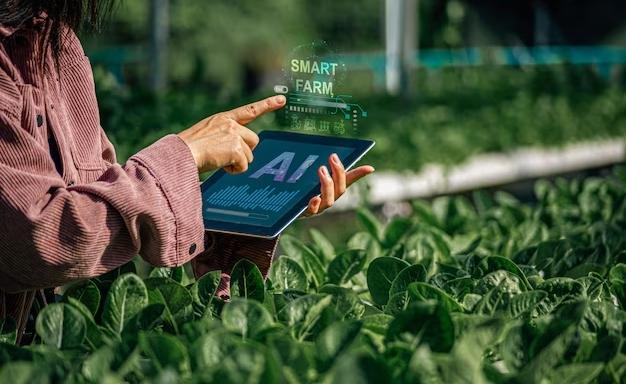
Alongside the physical system, FrugalTec introduces a production intelligence layer that monitors plants at an individual level. Light sensors track natural and supplemental light conditions across vertical zones. AI-supported imaging systems detect early signs of disease, stress, or growth irregularities before they spread. Environmental and crop data are continuously processed to support real-time decision-making for growers.
Over time, the system builds a cumulative understanding of production conditions, improving outcomes across cycles. In effect, the greenhouse becomes more capable the longer it operates.
Validation has come through both institutional recognition and direct market response. FrugalTec received early recognition at the Geneva International Exhibition of Inventions, followed by public innovation support for pilot deployments developed with academic and industry partners.
But the strongest signal has come from growers themselves. After initial industry exposure, the company received multiple qualified requests from producers seeking to increase output and diversify production without expanding land use.
The message is consistent: the industry does not need more greenhouses. It needs a different way to use the ones it already has.
The Multi-Value Crop Opportunity
Once vertical access to the plant becomes possible, the greenhouse stops being a single-purpose system. It becomes a platform. Food production is only one layer. Medicinal plants, pharmaceutical crops, and industrial crops can be integrated into the same controlled environment infrastructure. This shifts the greenhouse from a production unit into a multi-output biological system.
One example is natural rubber. Global demand remains high, while production is geographically concentrated. Research into alternative sources has identified the Russian dandelion as a viable candidate, with rubber-producing compounds concentrated in the root system. The challenge is not biological potential, but production feasibility at scale. A system that enables structured access to the entire plant, including roots, changes the underlying constraint.
FrugalTec is not currently producing dandelion rubber. The example is illustrative of a broader shift: controlled-environment agriculture is no longer limited to food crops. It can evolve into a multi-sector production platform spanning food, pharmaceutical, and industrial inputs within a single infrastructure layer. The greenhouse of the future may not be defined by crop type at all. It may be defined by capacity.
"The greenhouse industry has always looked at what grows above the soil. We designed a system that works with the whole plant."
Geometry. Operations. Intelligence.
FrugalTec reframes greenhouse innovation around three dimensions.
- Geometry: The unused volume inside existing greenhouses becomes productive space, increasing output without expanding footprint.
- Operations: Centralised plant-to-human workflows replace distributed labour movement, reducing inefficiency and enabling scalable automation.
- Intelligence: Continuous monitoring and AI-supported decision systems provide real-time visibility into plant-level conditions and production performance.
None of this requires rebuilding infrastructure. The greenhouse remains the same. What changes is how it is used.
For growers, this means higher productivity from existing assets, lower resource intensity, reduced operational complexity, and a system that improves over time. For agriculture, it means something larger: more output from the same footprint, reduced pressure on land and water systems, and infrastructure capable of supporting multiple crop categories simultaneously.
The third dimension was always there. Agriculture simply never had the tools to use it.
"We are not asking growers to change their business. We are giving them a dimension they have never been able to use."